

This comprehensive guide explores seven powerful time management strategies to help you work smarter, not harder. You will discover practical frameworks, actionable tips, and expert insights to eliminate distractions, prioritize effectively, and achieve better results in both your personal and professional life.
Why You Must Prioritize Your Daily Schedule

Learning how to control your hours determines your success and stress levels. Excellent time management is not about squeezing more tasks into your day. It is about focusing your energy on the right tasks at the right time. When you organize your workload effectively, you reduce burnout and improve the quality of your output.
Many professionals confuse being busy with being productive. You might spend ten hours at your desk but only accomplish two hours of meaningful work. By applying structured methods, you can align your daily actions with your long-term objectives. This alignment is crucial for goal setting strategies and overall career growth.
The Psychology Behind Productivity
Human brains are not wired for continuous, uninterrupted focus. Distractions compete for our attention constantly. Managing your schedule requires a deliberate approach to behavior change. By understanding your cognitive limits, you can design a workflow that leverages your natural energy peaks. High performers understand that optimal performance requires planned breaks and strict boundaries.
Strategy 1: The Eisenhower Matrix
The Eisenhower Matrix helps you categorize tasks based on urgency and importance. Former US President Dwight D. Eisenhower developed this concept to make difficult decisions quickly.
How It Works
You divide your tasks into four quadrants:
- Urgent and Important: Do these immediately. These are crises or hard deadlines.
- Important but Not Urgent: Schedule these. This quadrant is where deep work happens.
- Urgent but Not Important: Delegate these. These tasks require attention but do not require your specific expertise.
- Not Urgent and Not Important: Delete these. They are pure distractions.
Practical Application
Start your morning by listing every task on your agenda. Assign each item to one of the four quadrants. Most people spend too much time on urgent but unimportant tasks, such as answering non-critical emails. Shift your focus to the important but not urgent quadrant. This proactive approach prevents tasks from becoming emergencies. Mastering this matrix is a critical step in project management methodologies.
Expert Insight: Review your matrix at the end of each week. Notice which quadrants consume most of your hours and adjust your schedule accordingly.
Strategy 2: Time Blocking
Time blocking involves dividing your day into distinct blocks of time. Each block is dedicated to a specific task or group of tasks. This method prevents multitasking and forces you to focus entirely on one objective.
Implementing the Method
Open your calendar and schedule everything. Assign blocks for checking emails, writing reports, attending meetings, and even taking breaks. When a block begins, you work only on the assigned task. When the block ends, you stop.
- Estimate how long a task will take and add a twenty percent buffer.
- Group similar tasks together. For example, answer all emails in one thirty-minute block.
- Communicate your schedule to your team so they know when you are unavailable.
The Benefits of Scheduled Focus
Time blocking creates artificial deadlines, leveraging Parkinson’s Law, which states that work expands to fill the time available. By giving yourself strict limits, you increase your efficiency. It also reduces decision fatigue because your calendar tells you exactly what to do next. This is highly effective for maintaining healthy remote work habits.
Strategy 3: The Pomodoro Technique
Francesco Cirillo created the Pomodoro Technique in the late 1980s. This method uses a timer to break work into manageable intervals, traditionally 25 minutes in length, separated by short breaks.
Step-by-Step Guide
- Choose a single task to focus on.
- Set a timer for 25 minutes.
- Work continuously until the timer rings.
- Put a checkmark on a piece of paper.
- Take a five-minute break to stretch or walk around.
- After four cycles, take a longer break of 15 to 30 minutes.
Why Short Bursts Work
Working in short bursts keeps your mind fresh and focused. It turns large, intimidating projects into small, actionable steps. The frequent breaks prevent mental fatigue and help you sustain high energy levels throughout the day. It is one of the most reliable ways for overcoming procrastination because anyone can commit to working for just 25 minutes.
Pro Tip: Do not check your phone during your five-minute breaks. Give your brain a true rest from screen time to maximize cognitive recovery.
Strategy 4: The 80/20 Rule (Pareto Principle)
The Pareto Principle states that 80 percent of your results come from 20 percent of your efforts. In the context of your workload, a small fraction of your tasks generates the most significant value.
Identifying Your High-Impact Tasks
To use this principle, you must evaluate your responsibilities. Look at your to-do list and identify the tasks that directly impact your main goals. If you have ten items on your list, two of them will produce more value than the other eight combined.
Focus your energy on those two tasks. Complete them before you touch anything else. Delegate or delay the low-impact activities.
Maximizing Efficiency
Applying the 80/20 rule forces you to become ruthless with your priorities. You stop valuing tasks simply because they take a long time to complete. Instead, you measure tasks by their outcome. This shift in mindset is essential for effective time management and career advancement.
Strategy 5: Eat That Frog
Author Brian Tracy popularized the “Eat That Frog” method, inspired by a Mark Twain quote. The “frog” is your most difficult and important task—the one you are most likely to avoid.
Tackle the Hardest Thing First
Identify your biggest, ugliest task every evening for the next day. When you start your workday, tackle that task immediately. Do not open your email. Do not chat with coworkers. Eat the frog first.
The Momentum Effect
Completing your most dreadful task first thing in the morning creates massive momentum. It gives you a sense of accomplishment that carries you through the rest of the day. Every subsequent task feels easier by comparison. This method effectively neutralizes dread and anxiety associated with heavy workloads.
Strategy 6: The Getting Things Done (GTD) Method

David Allen developed the GTD method to help people clear their minds and organize their commitments. The core philosophy is to move tasks out of your brain and into an external system.
The Five Steps of GTD
- Capture: Write down every idea, task, and project in an inbox. Do not keep anything in your head.
- Clarify: Process your inbox. Decide if an item is actionable. If it takes less than two minutes, do it immediately.
- Organize: Put actionable items into appropriate categories or project folders.
- Reflect: Review your lists weekly to keep your system updated and relevant.
- Engage: Choose your next action based on your priority and available energy.
Creating a Trusted System
The GTD method works because it eliminates the stress of forgetting things. When you trust your external system, your brain can focus on executing tasks rather than remembering them. Integrating GTD with digital productivity tools can drastically improve your organizational skills.
Strategy 7: Energy Management
Not all hours of the day are created equal. Managing your time effectively requires you to manage your energy levels. You cannot force high-level analytical thinking when you are exhausted.
Map Your Energy Levels
Track your energy for a week. Notice when you feel most alert and when you experience a slump. Most people peak in the mid-morning, experience a dip after lunch, and have a second, smaller peak in the late afternoon.
Align Tasks with Energy
Schedule your most demanding, creative, or analytical tasks during your peak energy periods. Save routine tasks, such as replying to emails or organizing files, for your low-energy slumps. By working with your body’s natural rhythms, you accomplish more with less effort.
Pro Tip: Stay hydrated and optimize your sleep schedule. Physical health directly impacts your cognitive endurance and focus.
Comparison Table of Strategies
|
Strategy |
Best For |
Effort Level |
Key Benefit |
|---|---|---|---|
|
Eisenhower Matrix |
Decision fatigue |
Low |
Prioritizes tasks effectively |
|
Time Blocking |
Chaotic schedules |
Medium |
Creates uninterrupted focus |
|
Pomodoro Technique |
Short attention spans |
Low |
Prevents mental burnout |
|
80/20 Rule |
Heavy workloads |
Medium |
Maximizes task ROI |
|
Eat That Frog |
Chronic procrastination |
Low |
Builds early momentum |
|
GTD Method |
Complex projects |
High |
Organizes all commitments |
|
Energy Management |
Inconsistent output |
Medium |
Aligns tasks with biology |
Common Mistakes to Avoid
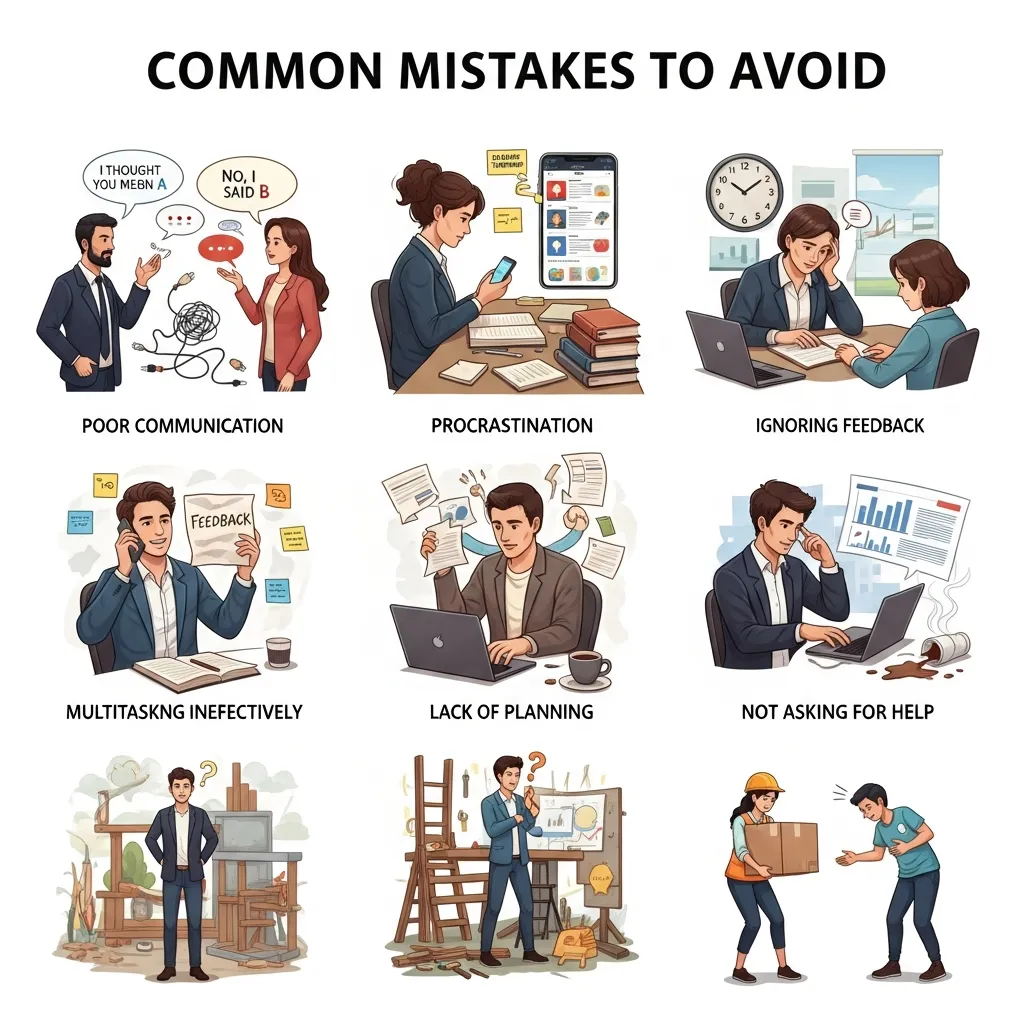
Even with the best intentions, people often fall into productivity traps. Avoid these common errors to ensure your efforts yield results.
Failing to Plan Ahead
Starting your day without a plan guarantees that distractions will hijack your focus. Always plan your day the night before. This allows you to start working immediately rather than wasting mental energy figuring out what to do.
The Multitasking Myth
Switching between tasks destroys your focus and increases errors. The human brain cannot process two complex tasks simultaneously. Commit to single-tasking. Focus entirely on one objective until it is complete or the scheduled block ends.
Ignoring Buffer Time
Work often takes longer than anticipated. Meetings run late, and emergencies happen. If you schedule your day down to the minute without buffers, one delay will ruin your entire plan. Always leave empty spaces in your calendar to absorb unexpected issues.
Chasing Perfection
Perfectionism causes massive delays. Learn to recognize when a task is good enough. Do not spend three hours formatting a document that only requires basic readability. Focus on completion over perfection.
Pro Tips for Sustained Success
To maintain high productivity levels over the long term, you must adapt and refine your approach continuously.
- Audit Your Time: Track every minute of your day for one week. You will uncover hidden time-wasters and realize exactly where your hours go.
- Learn to Say No: Protect your schedule fiercely. Decline requests that do not align with your primary goals. Every time you say yes to something unimportant, you say no to your priorities.
- Automate and Delegate: Use software to automate repetitive tasks. Delegate responsibilities that others can handle. Free up your time for high-level, strategic thinking.
By combining these methods, you build a resilient workflow that adapts to challenges. Successful time management is an ongoing practice, not a one-time fix. Consistently evaluate what works for you and discard what does not.
Conclusion
Master Time Management demands both strategies and consistency. By identifying high-impact tasks, structuring your day with time blocking, harnessing focused intervals through the Pomodoro Technique, automating or delegating routine work, and embedding micro-actions, you transform a busy calendar into a streamlined productivity engine. The journey starts with a single change—perhaps blocking out your next morning for uninterrupted creative work or setting your first Pomodoro timer. As you experience small successes, your confidence grows, and today’s tactics become tomorrow’s habits. Which technique will you adopt first? Commit to one step right now, and watch how quickly your days feel clearer, more productive, and infinitely more rewarding.
Frequently Asked Questions
What is the best method for organizing a busy schedule?
The best method depends on your working style, but Time Blocking is universally effective. It forces you to assign specific tasks to specific hours, eliminating guesswork and reducing the urge to multitask. Combine it with the Eisenhower Matrix to ensure you schedule the most important tasks first.
How can I stop procrastinating on difficult tasks?
Use the Eat That Frog strategy combined with the Pomodoro Technique. Identify your hardest task and commit to working on it for just 25 minutes first thing in the morning. Breaking the initial resistance is the hardest part. Once the timer starts, momentum naturally builds.
Does multitasking help you get more done?
No, multitasking actively destroys productivity. When you switch between tasks, your brain experiences a “switching cost,” leading to a loss of focus and increased errors. Single-tasking allows for deep work and faster, higher-quality completion of projects.
How do I know which tasks to prioritize?
Apply the 80/20 Rule and the Eisenhower Matrix. Identify the 20 percent of tasks that drive 80 percent of your results. Ensure these tasks fall into the “Important” category of your matrix. Prioritize tasks that align with your long-term goals over urgent but trivial requests.
What should I do if I get interrupted during a time block?
Protect your time blocks by setting boundaries. Turn off notifications and inform colleagues of your focused hours. If an unavoidable interruption occurs, handle it quickly, note where you left off, and immediately return to your primary task once the interruption is resolved.
How can I maintain my focus throughout an eight-hour day?
You cannot maintain intense focus for eight hours straight. Manage your energy by working in 90-minute intervals followed by 15-minute breaks. Tackle demanding tasks during your peak energy hours and save administrative duties for when you feel tired.
Why do my to-do lists make me feel overwhelmed?
To-do lists become overwhelming when they lack structure and priority. A list of thirty random tasks causes anxiety. Instead, use the Getting Things Done (GTD) method to organize tasks by context and priority. Limit your daily active list to no more than three to five critical items.
Is it necessary to plan every single minute of my day?
No, over-scheduling leads to frustration. Always include buffer times. Plan about 70 to 80 percent of your day, leaving the remaining time open for emergencies, breaks, and mental recovery. Flexibility is a core component of sustainable productivity.
Can technology improve my daily efficiency?
Yes, the right digital tools streamline workflows. Calendar applications help with time blocking, while task managers keep your projects organized. However, technology can also be a distraction. Choose simple tools that support your habits rather than overcomplicating your system.
How long does it take to build new productivity habits?
Behavioral science suggests it takes an average of 66 days to form a new habit. Start small. Implement one strategy, such as setting a 25-minute timer for your first task, and practice it daily. Once it feels natural, introduce another technique to your routine.